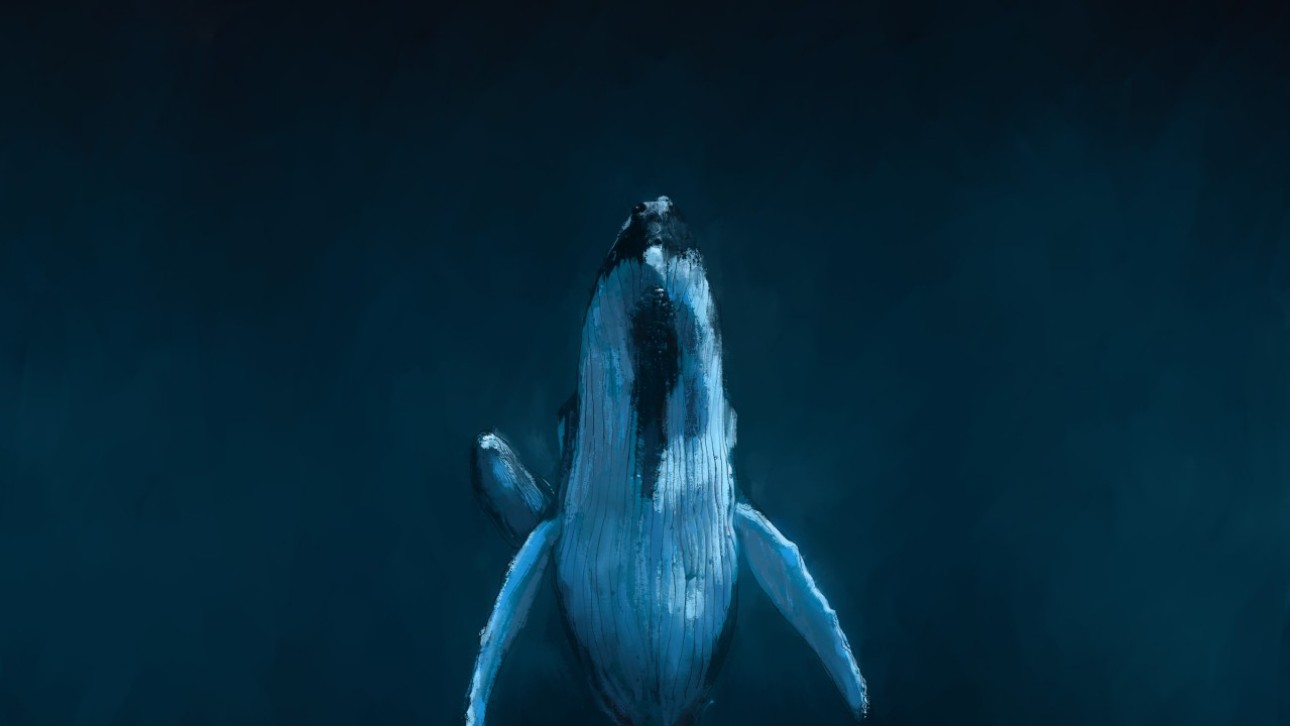
Over the past two years, I have been developing a project called The Sea Within. The central idea of this project is that the cyclicism of the whale’s journey, both across the Pacific Ocean, and across generations, holds important lessons for us in how we understand our own lineage. It is an artwork for everyone, intended to offer a doorway to an undercurrent of emotion we all carry, but which originated long before us. From an experiential point of view, the artwork will simulate the experience of being underwater surrounded by the whales in their serene resting posture. Wraparound projections of underwater footage will be accompanied by a soundtrack that evokes the philosophical and spiritual journey of whales, giving viewers the sensation of being cocooned by the ocean.
Every summer, whales of the South Pacific migrate from the Pacific islands to Antarctica to feed, returning to the islands in winter where they breed and rest with their young. Not long ago in human history, we hunted these whales almost to extinction in Antarctic and Polynesian waters. Only 6-15 female whales were left in Tonga. Exterminated on their migratory paths, there was huge loss of not only life, but of the knowledge of where to go. The fact their cultural knowledge survived is a mark of phenomenal resilience among these whales in the face of unimaginable loss and grief.
When I started my research on this topic, one of the most intriguing things I discovered was the notion of intergenerational grief, an experience shared by whales and people. This research prompted me to think about my own ancestry and explore my family’s migratory history.
My grandmother was among the 733 Polish children who survived forced deportation to Soviet Union labour camps and was eventually given a home in New Zealand in 1944. Her story began in a peaceful Polish village and followed her family’s harrowing journey to a labour camp in Siberia, her flight to freedom, and her orphan voyage to safe refuge in New Zealand with her brother.
Growing up, I didn’t understand why she didn’t speak a word of Polish, or talk about her experiences in Europe. I would ask my great uncle to tell me about his memories from Poland, and he would tell me he couldn’t remember. As an adult I read (and recently re-read) Halina Ogonowska-Coates’s Krystyna’s Story, a heart-rending account of the journey of these 733 children, combined into the single narrative of a fictional Polish girl. This book opened my eyes to what my grandmother endured. Knowing my great uncle had probably been shielding my child self when he said he didn’t remember, I’ve often wondered if my grandmother shared any memories with her own children. My aunt told me that the only thing she ever mentioned was that she remembered waking up in a Siberian forest, frozen to the ground.
Perhaps as an antidote to hearing this story, I began to explore mindfulness and alternative ways of connecting with nature, such as the practice of forest bathing. Research shows that immersion in forests and other natural environments allows the prefrontal cortex, the brain’s command centre, to dial down and rest, like an overused muscle. Nature’s healing powers became the basis of a spiritual and emotional case for creating the world’s first national parks. This image of soaking in the stillness of nature made me think about the way whales rest with their young in a serene and other-worldly vertical resting posture. I was once again called to understand this shared psychology of inherited grief.
Intergenerational grief is defined as grief that gets passed down from those who directly experience an incident to subsequent generations. While the existence of intergenerational trauma is well evidenced, the mechanisms of its transmission remain unclear. I was introduced to some academic research being done here in New Zealand on intergenerational grief, and the remarkable connection we share with whales around this psychological inheritance. This research would lead me to begin developing an artwork connecting these different threads, The Sea Within.
My journey as an artist in creating The Sea Within inevitably posits this story of wayfinding — across oceans and across generations — in the Aotearoa context. The Sea Within encourages a way of seeing and being that is encapsulated by Mātauranga Māori. This is a mode of knowledge-seeking that defers to whakapapa or foundations, and respects the manifold nature of our relationship with the earth. In the final installation, viewers will be guided to view the whales through the lens of genealogy and cultural transmission, their journey connecting us to our Pacific Island neighbours.
One of the initial collaborators on this project was Rochelle Constantine, a world leading marine biologist based out of the University of Auckland. In collaboration with Ngāti Kuri, Rochelle led an expedition that used satellite tagging to track humpback whale movement and song around the Kermadecs. The results revealed an astonishing phenomenon: each year, the whales gather around the Kermadecs and share song. Analysis of this songsharing has shown that not only is this a cultural exchange; the songs also seem to impart precious migratory wisdom.
The connection between people and whales stretches beyond Aotearoa, to our Pacific neighbours. For the people in Tonga, the connection with the ocean and the whales remains strong. Their ancestors were voyagers and navigators who journeyed across the Pacific and learnt to read the ocean. As a result, the boatbuilders and fishermen of Ha’apai and the ocean people of Vava’u together understand the vitality of the ocean and the sheer strength and intelligence of the whales.
As I deepen my understanding of the experiences my grandmother endured as a child and then carried for her whole life as a mother then grandmother, The Sea Within has become a deeply personal journey for me. By visually and acoustically capturing the cultural memory of migration that drives these whales across the vast Pacific every year, my intention is to translate the emotional trace left by these memories into an artwork that holds space for all of the emotions we carry with us and pass on. The artwork will draw parallels between the whale and human journey by interpreting this exchange of culture and wisdom, with the aim of inspiring deeper connection with the ocean and the wider natural world.