On the way back to New Zealand from our Antarctica expedition in 2015, the crew were keen to explore South America. Some went to Uruguay, some to Argentina and some to Chile. My friend Simon and I were drawn to Brazil. My older brother had lived there, and Simon had always wanted to go to Rio de Janeiro during Carnival.
We arrived in Rio de Janeiro at night and caught a taxi from the airport to Copacabana. It was like a ride at Disneyland: a roller coaster through lights, motorways, and favelas unrolling across hills and enveloping the motorway like bougainvillea. I had been to big cities before, but this was an alternative version of a metropolis that I had never experienced. The yellow incandescent lights of the motorway made the journey feel like a video game.
After a month in Antarctica, Rio de Janeiro was a sensory explosion. Antarctica is the purest palette of whites, blues and greys. It is the most naturally pristine place on earth, silent save for the crunching and crackling sounds ricocheting across the tabular landscape of enormous icebergs. Rio, on the other hand, was a melting pot of colour, light, people and partying. On the tail end of Carnival, the atmosphere is especially vibrant. Processions of bands would take over the streets, going from bar to bar to be greeted by throngs of people dancing.
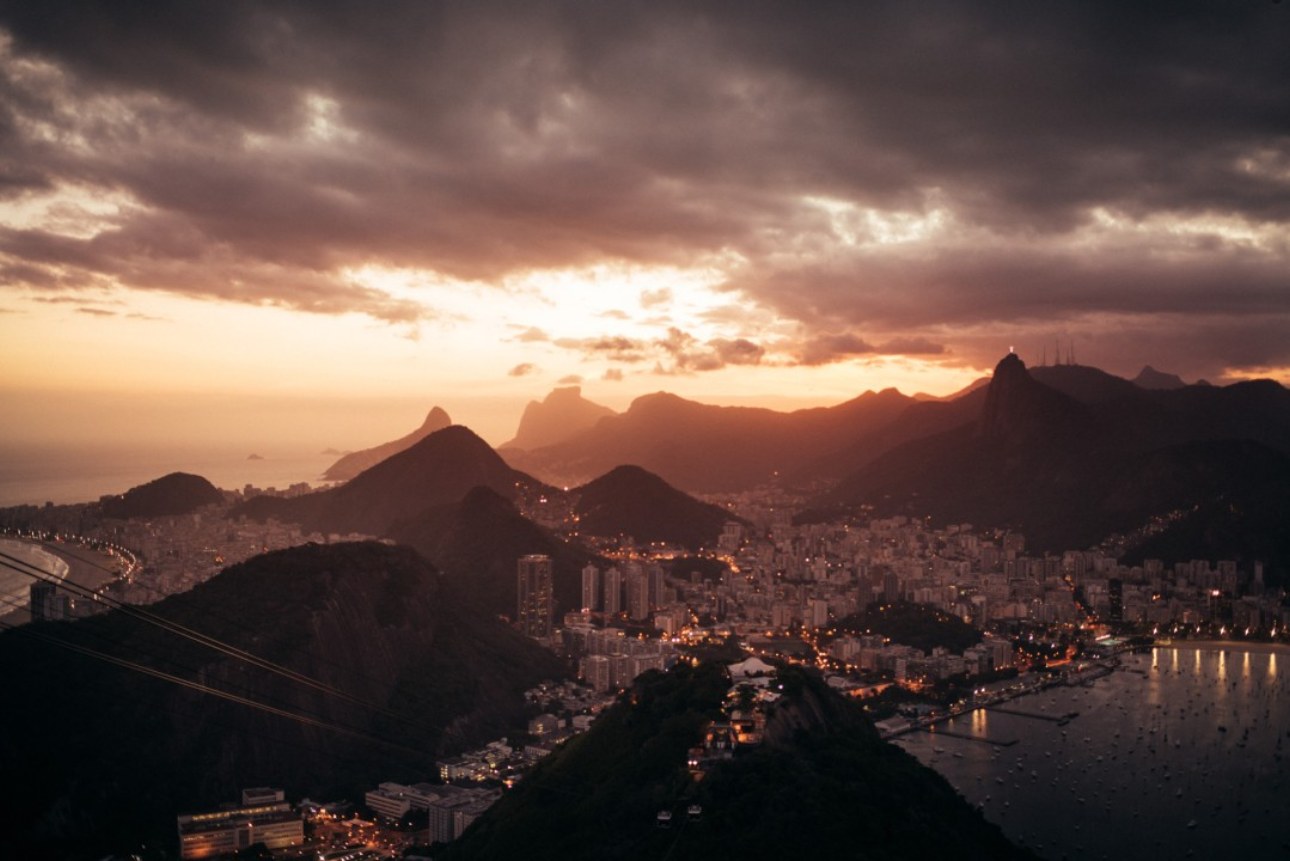
There is a famous spot at Arpoador where people stop to watch the sunset. Simon and I went there in the evening and sat in the water. Before we knew it, a wave of orange and pink crested over the horizon and spread across the sky. It was the most perfect gradation of colour I had ever seen. As a cinematographer, Simon was working on a project creating live action miniature photography at the time, and remarked how impossible it is to recreate that colour gradation in a studio.
As the sun descended, its light was broken by the peaks of the surrounding mountains and huge triangular shadows were cast into the sky. Too steep to build on, these forested mountains tower over the city and cascade down to the coast, contributing to the city’s unique fusion spirit where both nature and humankind thrive within the frame of a single dramatic landscape.
When I returned to Brazil for New Years Eve a couple of years later, this melding of nature and people was even more pronounced. Parties spilled onto the streets from every apartment building and joined to form a colourful sea of over two million people on the beach to watch the largest fireworks display on the planet. As eyes were drawn up to the sky, I remember the way the buildings formed an amphitheatre, ricocheting the pops and explosions back out into the sea. A glittery, supersonic version of another tabular soundscape I had witnessed two years prior.
When Simon and I landed in Rio after our month in Antarctica, our instinct was to see the stark contrast and nothing else. The possibility that these two wildly opposed places could be similar in any way did not occur to us — until we sat in the water at Arpoador at sunset and looked up at the sky. We are taught to believe nature and culture are opposed; that serenity and festivity cannot coexist; that wilderness withers in the presence of humans. But from my experiences of Rio, this zero-sum view does not do justice to the natural environments surrounding us, and its endurance even in the face of the most chaotic of humankind.
Culture is certainly its own force — nowhere more so than in cities like Rio — and yet no matter where you are in the world, the power, beauty and purity of nature cannot be overlaid completely. The remote environments I’ve made it my mission to recreate for urban audiences are closer than we think.